Fresh Drops vs Auction Inventory: Where New Expiries Surface
The most common beginner confusion in this market is a geography problem: where do expired domains actually go first? The answer is a pipeline with three exits, and the names everyone wants mostly leave through the first one. Once you see the flow, you stop wondering why a "dropped domains" list and an "expiring auctions" list barely overlap, and you start choosing which pool fits what you are buying.
Exit one: expiry auctions, while the owner can still renew
During the registrar grace period (0-45 days after expiry), many registrars list the expiring name in their own auction. GoDaddy alone adds 35,000+ new expiring domains daily, with soft-close bidding and a membership costing about $5 per year; Dynadot runs auctions plus a descending closeout ladder of roughly $30, then $15, then $5; Namecheap Market carries its own expiry stream and, since February 2025, the official daily auctions for expired .ai names, which never free-drop at all. If someone wins the auction, the domain transfers without ever dropping, and, crucially, it keeps its original registration date and age. A renewal by the owner cancels everything. Bidder beware in 2026: GoDaddy's February terms update removed some bidder protections, which we covered in detail.
Exit two: the drop pool
Names that go unsold and unrenewed pass through the 30-day redemption period into five days of pendingDelete, then release; .com and .net drop in a daily batch starting around 2:00 pm US Eastern. This is the "fresh drops" pool this site is named for. Its scale is genuinely large, with anywhere from roughly 100,000 listed to 200,000+ deleted names per day depending on how you count, but it is adversely selected: names with obvious broad appeal were usually bought at auction or backordered before release. A drop catch is also a brand-new registration, so age and WHOIS history reset. What survives here rewards narrow filters and patience rather than raw speed, which is the freshness game in its purest form.
Exit three: post-catch auctions
Contested catches resurface fast. DropCatch, with its 1,200+ registrar accreditations, rolls multi-backorder catches into public auctions; park.io opens a 10-day auction when a $99 catch is contested; NameJet and SnapNames run member auctions at $69-79 minimums from their shared pool. For buyers without backorder infrastructure, this third pool is a second chance at drop-pool names, at market prices set by whoever else showed up.
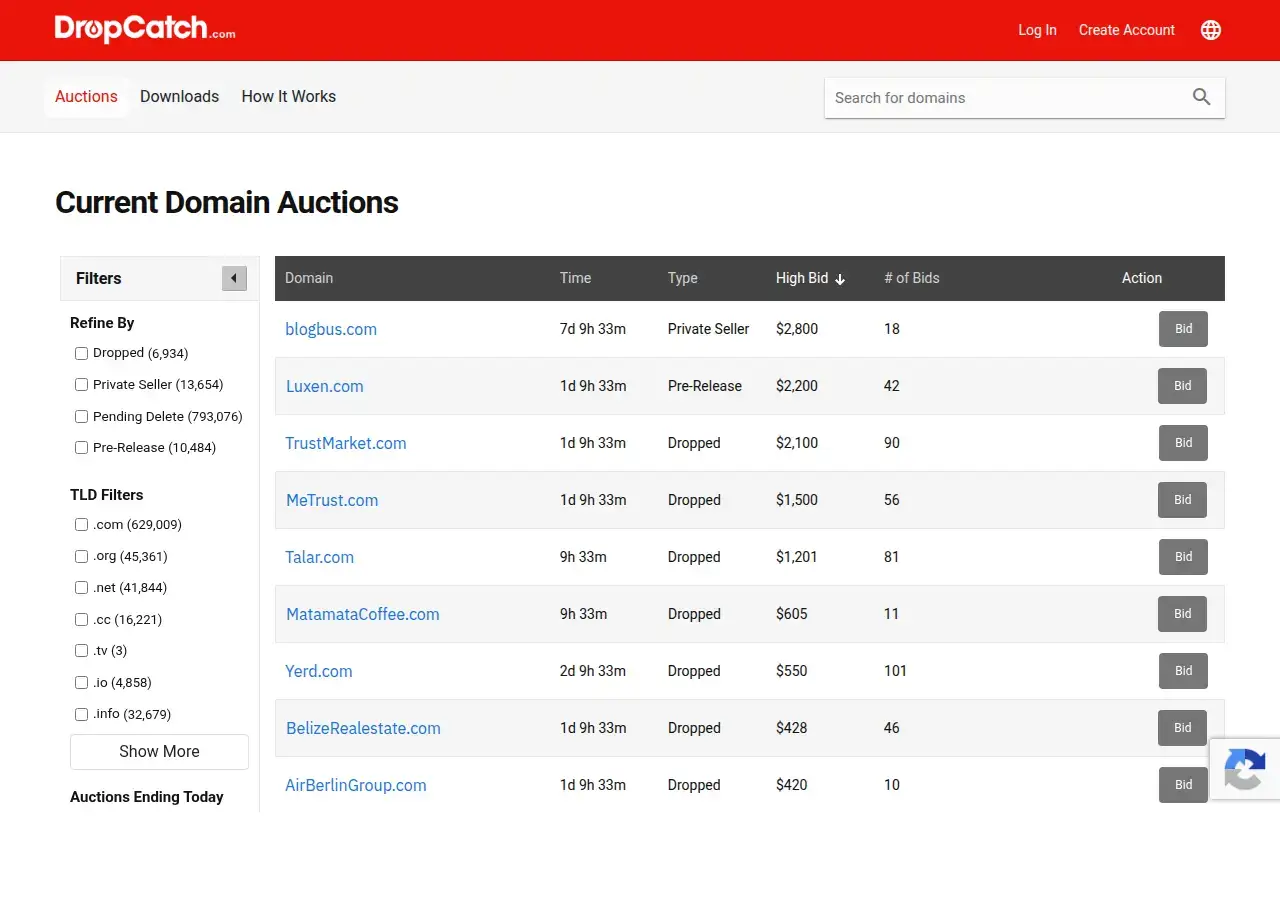
Exit three in the wild: DropCatch's public auction board, where contested catches resurface, captured August 2026
Where to watch each pool, ranked
Ranked by results per hour of your attention, because that is the resource that actually runs out. The reason a paid aggregator tops a list containing free giants is data depth: one filtered view spanning all three pools, with metrics and spam signals attached to every row, replaces separate visits to each venue and a spreadsheet to reconcile them.
| Rank | Source | Pools covered | Cost |
|---|---|---|---|
| 1 | DomCop | Expiry auctions, pending delete, dropped names and post-catch auctions in one filtered view, metrics attached | From roughly $68/mo on annual plans; no free trial, 2-day money-back |
| 2 | ExpiredDomains.net | The broadest free view: daily dropped and pending-delete lists across 676 TLDs; registration unlocks filters | Free |
| 3 | GoDaddy Auctions | The largest single expiry-auction stream, 35,000+ new names daily, soft close | ~$5/yr membership |
| 4 | Dynadot | Expiry auctions plus the $30/$15/$5 closeout ladder for bargain hunters | Free to browse |
| 5 | Namecheap Market | Registrar expiry auctions, including the official daily expired .ai stream | Free to browse |
| 6 | SpamZilla | Drop-pool lists with its SZ spam score, processing ~300k domains/day; thinner venue coverage than the leader | From $37/mo |
| 7 | DropCatch | Pending-delete backorders ($13-59) and public post-catch auctions | Free to browse |
Honest calibration: at low volume, the free routes are enough. ExpiredDomains.net is the best starting point anyone can use today at zero cost, and every registrar stream is browsable for nothing. The paid view earns its fee when you check daily, hunt across pools at once, or need vetting data attached at list speed.
The timing seams between the pools
The three exits sit on one fixed calendar, and the seams between them are where buyers make or lose their chances. During the grace period the name is auction inventory, and losing that auction is final: a sold name never drops, so there is no second bite. If the auction ends unsold, the name goes quiet through the 30-day redemption period, a stretch where nothing is buyable and impatient hunters simply lose track of it. Then pendingDelete opens a 5-day window with a hard convention: backorders in before the final day. Miss that seam and your remaining options are the release scramble and whatever post-catch auction follows. The operational habit that exploits this is a dated log: every interesting name gets a next-action date the moment you first see it, whether that is an auction close, a redemption expiry estimate, or a backorder deadline.
Which pool should you actually shop?
- You want age and continuity (SEO rebuilds, brand history): shop expiry auctions, because a pre-drop purchase keeps the original registration date. Losing that to save a few dollars at the drop is a bad trade.
- You want cheap volume and long-tail finds: shop the drop pool with narrow filters and hand-register survivors for the registration fee.
- You want contested quality without running backorders: watch post-catch auctions, where the catching infrastructure already did its work and the price is the only question left.
Frequently asked questions
Do all expired domains eventually reach the drop?
No. Renewed names never leave their owner, redeemed names come back during the 30-day redemption window, and auctioned names transfer to a new owner without dropping. The drop pool is what remains after those exits.
Which is cheaper, expiry auctions or the drop?
Uncontested drop names are the cheapest thing in the market: a registration fee. Anything contested carries a market price wherever it surfaces, and auction prices for visible names are often similar before and after the drop, because the same bidders show up in both places.
Does buying at an expiry auction keep the domain's age?
Yes. The registration continues uninterrupted, and the original creation date survives. A drop catch, by contrast, starts a brand-new registration with a reset date and history, even though backlinks elsewhere keep pointing at the name.
Why do sources disagree about how many domains drop daily?
Definitions. Roughly 100,000 names appear on expiring and dropped lists daily, while total deletions across all TLDs and record types can run past 200,000. Neither number is wrong; they count different events, as of mid-2026.
What happens to names nobody buys in any pool?
They drop, stay registrable, and sink into the long tail. Some get picked up weeks later by patient niche hunters, some are re-registered and dropped again in future years, and most simply sit available, which is the honest fate of the majority of the daily pool.