Why Fresh Drops Beat Stale Lists
Every list of expired domains is a photograph of inventory that other people are actively removing. Somewhere between 100,000 listed and 200,000+ deleted names move through the pool every day, depending on how you count, and the tiny fraction worth owning is exactly the fraction that disappears first. This article is the argument the whole site is built on: where the decay comes from, how fast it runs, and how to position a workflow ahead of it instead of behind it.
How fast does a good domain actually disappear?
The best names never reach a stale list at all. During the five days a .com spends in pendingDelete, drop-catching services stack backorders against it. When Verisign releases the day's deletions around 2:00 pm US Eastern, DropCatch alone fires registration attempts through 1,200+ accredited registrar connections, and contested names are settled in milliseconds. Even the top catching services land only an estimated 30-50% of the names they chase, which tells you how many other buyers wanted the same name you did.
The next tier disappears within hours. Names that slip through the drop with visible referring domains, a clean history or an obvious keyword get hand-registered by whoever was watching the freshest list that morning. What survives 24 hours is, by definition, what the fastest layer of the market examined and declined. By day three the pool is not smaller, it is adversely selected: the quantity is still enormous, but the density of value has collapsed.
Three clocks run against every list
- The backorder clock starts before the drop. Pending-delete lists show tomorrow's inventory today, so serious buyers commit money while a name is still technically owned by nobody. By the time a dropped name appears on a normal list, this clock has already run out.
- The hand-registration clock starts at release. A dropped name with real backlinks costs only the registration fee, so the reward for being first is enormous relative to the spend. Whole workflows exist purely to sweep fresh drops before breakfast.
- The auction clock runs in parallel. Expiring names surface in registrar expiry auctions during the grace period, 35,000+ new ones daily at GoDaddy alone, and bidding often ends before the name would ever have dropped.
What is the same list worth at four ages?
| List age | What is still in it | Who you compete with | Best use |
|---|---|---|---|
| Live (auctions, pending delete) | The full stream, including names that have not dropped yet | Backorderers and auction bidders | Winning contested names |
| Same day (0-24 hours) | Today's drop minus everything caught at release | Fast hand-registrants | Clean uncontested pickups |
| One to three days | A picked-over pool where obscure niches survive | Occasional stragglers | Long-tail and niche finds |
| A week or older | The leftovers of five or more earlier shopping trips | Almost nobody | Keyword and pattern research, not buying |
Why do stale lists still dominate the search results?
Because publishing about expired domains pays better than refreshing data about them. As of mid-2026 you can still find roundups recommending FreshDrop, a once-popular drop tool whose own domain expired in 2024, and JustDropped, whose site is unreachable. A guide that recommends dead tools is the article version of a stale list, and it should recalibrate your trust in anything undated.
The lists themselves age the same way. A "great expired domains right now" post is frozen at publication: the names in it were caught, hand-registered or re-dropped long ago. Data has a shelf life measured in hours; articles pretend it is measured in years. When you evaluate any source, the first question is not how many domains it shows but when it last refreshed, which is why our ranking of live sources is ordered by lag rather than by size.
How can you tell whether a source is actually fresh?
Four checks take a minute. Look for a visible refresh timestamp, and distrust any list without one. Confirm a pending-delete view exists and shows names dated tomorrow and later, since forward-looking data is the hardest kind to fake. Spot-check five random rows: on a fresh list, most uncontested names still register cleanly, while on a stale one you will find names already parked by their new owners. Finally, compare row counts across two visits a day apart; a pool this size turns over visibly every 24 hours, so identical numbers mean a frozen snapshot wearing a live costume.
How do you buy freshness without overpaying?
Freshness comes in a ladder, and each rung costs more than the one below it:
- Free daily databases. ExpiredDomains.net refreshes daily across 676 TLDs, and free registration unlocks its filters. Lag: up to a day, plus whatever time you spend filtering manually.
- Pending-delete sections. The same free sources list names 1-5 days before they drop. This is tomorrow's inventory today, and it converts a reaction game into a planning game.
- Registrar expiry auctions. Live inventory during the grace period, free to browse at GoDaddy, Dynadot and Namecheap. The freshest view of names that may never drop at all.
- Paid aggregation. DomCop refreshes daily across auction, pending-delete and dropped pools with metrics already attached, which compresses hours of manual vetting into one filtered view. It starts at roughly $68 per month on annual plans, has no free trial, and offers a 2-day money-back guarantee, so it only makes sense once your volume justifies it.
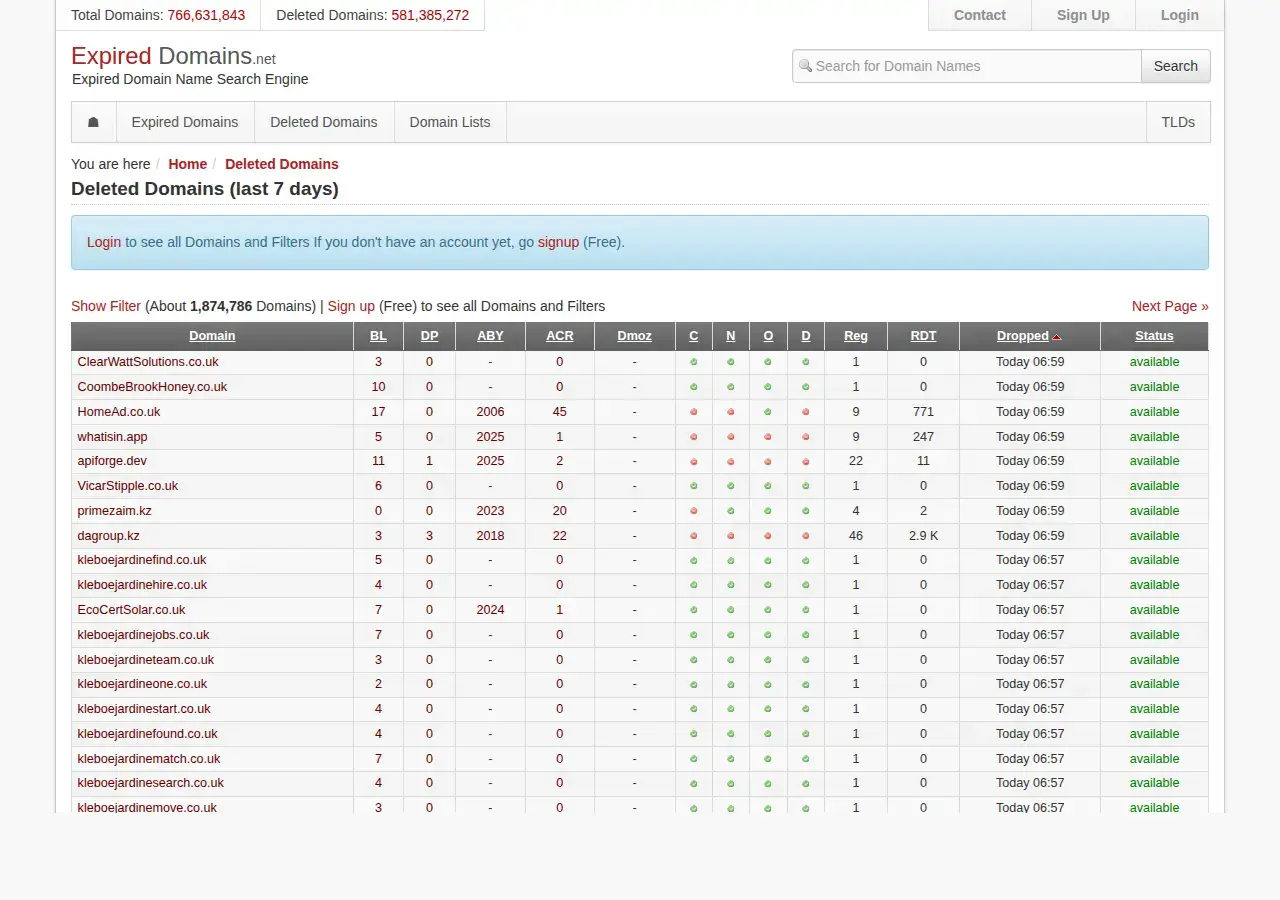
The free rung of the ladder: ExpiredDomains.net's deleted-domains list, refreshed daily, captured August 2026
Honest calibration: if you hunt obscure long-tail names, a free daily refresh is genuinely fresh enough, because nobody is racing you. Pay for freshness when you compete for contested names, when you need metrics attached at scale, or when the hour saved every morning is worth money to you.
The cadence this site is built around
Everything published here assumes lists rot. That is why the practical guides emphasize daily rhythms, pending-delete lead time and same-day vetting rather than monthly roundups of names that will be gone by the weekend. Treat every list you meet, including ours, as a photograph with a timestamp, and always check the timestamp first.
Frequently asked questions
Are day-old expired domain lists worthless?
No, they are adversely selected rather than empty. Obscure niche names with modest metrics routinely survive days because nobody was hunting them. What a day-old list will not contain is anything the fast layer of the market recognized as valuable.
What counts as a fresh drop?
A practical definition: a name that dropped within the last 24 hours, or one still in pendingDelete that has not dropped yet. Both windows let you act before the broad market has fully digested the name.
How fast do the best expired domains go?
Contested names are decided in milliseconds at the daily release by backorder engines, and even top services catch an estimated 30-50% of what they chase. Visibly clean uncontested names typically last hours, not days.
Is a paid fresh feed worth the money?
Only at volume. Casual hunters in quiet niches do fine with free daily lists. Paid aggregators like DomCop earn their fee when you check lists daily, compete for contested names or need spam-vetting metrics attached to every row.